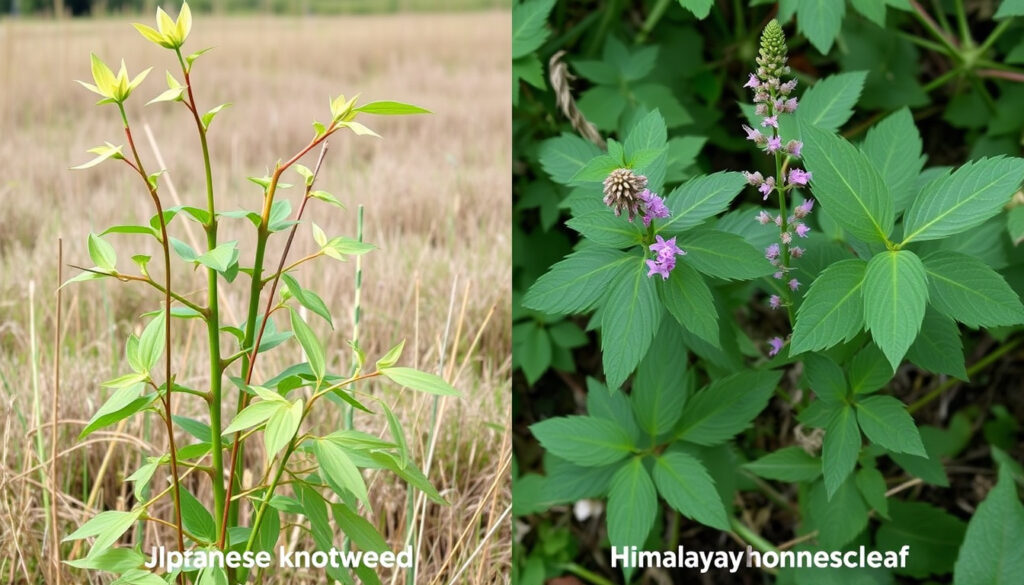
Mistaken Plants That Look Like Japanese Knotweed: ID Guide
Few things cause a gardener’s heart to sink faster than the sight of suspicious red shoots in spring. But not every vigorous stem belongs to Japanese knotweed — and misidentifying a harmless plant can be just as costly as overlooking the real invader. The plant’s bamboo-like stems and zig-zag pattern are hallmarks, yet several common UK species share similar features, especially in early growth. This guide compares leaf, stem, and flower morphology of the most frequent lookalikes, so you can tell the difference with confidence.
Depth of rhizome penetration: Up to 3 m (RHS) ·
Number of lookalike species: At least 8 (Gardeners’ World) ·
Legal status UK: Schedule 9 offence to cause spread (UK Government)
Quick snapshot
- Shield-shaped leaves with flat base (Gardeners’ World)
- Hollow, bamboo-like stems with purple speckles (Gardeners’ World)
- Rhizomes orange inside, brittle (RHS)
- Offence to plant or cause spread under Wildlife and Countryside Act 1981 (UK Government)
- Introduced to Britain in the 19th century as ornamental (RHS)
- Spread rapidly via rhizomes; now widespread across UK (RHS)
- Spring emergence of red-purple shoots (asparagus-like) March–April (RHS)
- Homeowners should monitor gardens and consult a specialist if suspected (Knotweed Services)
The table below summarises the key identification features of Japanese knotweed at a glance.
| Attribute | Details |
|---|---|
| Scientific name | Reynoutria japonica (syn. Fallopia japonica) |
| Family | Polygonaceae |
| Native to | Japan, China, Korea |
| Height | 2–3 m (up to 10 cm per day in summer) (RHS) |
| Leaf shape | Shield-shaped (truncate base, pointed tip), alternate |
| Stem | Hollow, bamboo-like, purple speckles, zigzag (Gardeners’ World) |
| Flower | Creamy-white panicles, late summer–autumn |
| Rhizome | Orange inside, brittle, up to 3 m deep and 7 m laterally (RHS) |
| UK legal status | Schedule 9, Wildlife and Countryside Act 1981 – offence to plant or cause spread (UK Government) |
The pattern is clear: no single feature is enough, but the combination of these traits is unique to Japanese knotweed.
What plants look similar to Japanese knotweed?
Most lookalikes share either leaf shape or stem appearance with knotweed, but none combine all three of its hallmark traits: hollow zigzag stems, shield-shaped alternate leaves, and brittle orange rhizomes.
Himalayan balsam (Impatiens glandulifera)
- Spade-shaped leaves with serrated edges, pink hooded flowers (Gardeners’ World)
- Hollow, greenish-red stems resemble knotweed but flowers are distinct (Gardeners’ World)
- Annual plant, grows up to 2.5 m, does not have persistent rhizome network (Phlorum)
Bindweed (Convolvulus arvensis)
- Arrow-shaped leaves with deep basal lobes, not shield-shaped (Japanese Knotweed Expert)
- Climbing perennial vine, not upright like knotweed (Japanese Knotweed Expert)
- White or pink funnel-shaped flowers, solitary; knotweed flowers are creamy panicles
Russian vine (Fallopia baldschuanica)
- Similar creamy white flower panicles in late summer (Phlorum)
- Climbing habit, smaller ovate leaves, stems not hollow (Phlorum)
Dogwood (Cornus spp.)
- Leaves opposite on the stem (knotweed alternate) (Phlorum)
- Shield- or heart-shaped leaves with prominent veins, stems often red in winter (Phlorum)
Lilac (Syringa vulgaris)
- Heart-shaped leaves, opposite arrangement (Phlorum)
- Thick, leathery leaf texture; woody stems, not hollow
- Not invasive; garden shrub with fragrant purple flowers
Broadleaf dock (Rumex obtusifolius)
- Large, wavy-edged leaves in basal rosette, not shield-shaped (Gardeners’ World)
- Solid stems, spreads mainly by seed, not rhizomes (Gardeners’ World)
How to tell if a plant is Japanese knotweed?
Leaf shape and arrangement
- Shield-shaped with a flat base (truncate) and pointed tip (Gardeners’ World)
- Leaves arranged alternately along the stem, not opposite
- Can reach 10–14 cm at maturity (Gardeners’ World)
Stem characteristics
- Hollow, bamboo-like with purple speckles (Gardeners’ World)
- Grows in a distinct zigzag pattern between leaf nodes
- Stems die back in winter, leaving reddish-brown canes
Growth habit and height
- Upright, freestanding herbaceous plant reaching 2–3 m (RHS)
- Forms dense thickets, outcompetes native vegetation
Flower appearance
- Creamy-white panicles in late summer to autumn (RHS)
- Small, numerous flowers in branched clusters
Rhizome system
- Orange interior, brittle, can regrow from tiny fragments (RHS)
- Extend up to 3 m deep and 7 m laterally (RHS)
Even experienced surveyors can misidentify knotweed when only young shoots are present. The RHS advises waiting until leaves are fully expanded before making a final call, and consulting a specialist if doubt remains.
What is the difference between Persicaria and Japanese knotweed?
Leaf differences
- Many Persicaria species have a dark purple chevron or blotch on the upper leaf surface, absent in knotweed (Gardeners’ World)
- Persicaria leaves are often narrower and lack the shield shape
Stem color and texture
- Persicaria stems are usually green or reddish and solid, not hollow like knotweed (Phlorum)
- No zigzag growth pattern
Invasive status comparison
- Some Persicaria species (P. campanulata, P. wallichii) are invasive in parts of the UK (Gardeners’ World)
- Japanese knotweed is a controlled invasive species with legal obligations; Persicaria is not regulated under Schedule 9
The implication: Persicaria may be a garden nuisance, but it carries none of the legal weight of Japanese knotweed.
How to tell the difference between bindweed and knotweed?
Leaf shape
- Bindweed leaves are arrow-shaped with deep basal lobes; knotweed leaves are shield-shaped without lobes (Japanese Knotweed Expert)
Growth form (climbing vs upright)
- Bindweed is a climbing vine that wraps around supports; knotweed stands upright (Japanese Knotweed Expert)
Flower structure
- Bindweed flowers are funnel-shaped, white or pink, solitary; knotweed has small creamy panicles in clusters
Are Persicaria invasive?
Invasive Persicaria species in the UK
- Persicaria campanulata and Persicaria wallichii are considered invasive in some UK regions (Gardeners’ World)
- They spread by seeds and runners but lack the deep rhizome system of knotweed
Differences from knotweed in spread
- Persicaria does not produce orange brittle rhizomes; its root system is fibrous and shallow (Phlorum)
- Seed dispersal is the main propagation method, not fragmentation
Management recommendations
- For invasive Persicaria, cutting and herbicide are effective; removal is less regulated than knotweed (Phlorum)
- No legal requirement to notify authorities, unlike knotweed
What does Japanese knotweed look like when it starts to grow?
Early spring shoots (asparagus-like)
- Red/purple asparagus-like shoots emerge from the ground in March–April (RHS)
- Shoots grow rapidly, up to 10 cm per day in ideal conditions
Young leaf development
- Young leaves are initially red-tinged, then turn green and expand to the characteristic shield shape (Gardeners’ World)
- At this stage, leaf arrangement (alternate) is the most reliable identifier
Mistaken identification during regrowth
- Dogwood and lilac shoots can look similar before leaves fully form (Phlorum)
- Careful attention to leaf arrangement and stem hollowing avoids misidentification
One pattern across all these comparisons: the combination of alternate leaves, hollow zigzag stems, and orange rhizomes is unique to Japanese knotweed. No lookalike shares all three traits. The implication for UK gardeners and homeowners is clear — if a plant has opposite leaves or solid stems, it is not knotweed.
The table below provides a side-by-side comparison of the key features of each lookalike species.
| Plant | Leaf shape | Leaf arrangement | Stem | Growth form | Invasive (UK) |
|---|---|---|---|---|---|
| Japanese knotweed | Shield-shaped, flat base | Alternate | Hollow, zigzag, purple speckled | Upright, 2–3 m | Schedule 9 |
| Himalayan balsam | Spade-shaped, serrated | Opposite or whorled | Hollow, greenish-red | Upright, to 2.5 m | Invasive (non-regulated) |
| Bindweed | Arrow-shaped, basal lobes | Alternate | Solid, twining | Climbing vine | Common weed |
| Russian vine | Ovate, smaller | Alternate | Solid, climbing | Climbing to 4 m | Not regulated |
| Dogwood | Heart-shaped, prominent veins | Opposite | Solid, often red in winter | Shrub | Not invasive |
| Lilac | Heart-shaped, leathery | Opposite | Woody, solid | Shrub | Not invasive |
| Broadleaf dock | Wavy-edged, basal rosette | Basal | Solid, sometimes reddish | Upright, to 1.5 m | Common weed |
The pattern: leaf arrangement alone — opposite versus alternate — is the fastest way to exclude most lookalikes.
Using the table above, a homeowner can rule out knotweed in under 30 seconds by checking leaf arrangement alone. If the leaves are opposite, the plant is not Japanese knotweed — saving potentially thousands in unnecessary professional surveys.
Expert perspectives
“Japanese knotweed can be identified in early spring by red-purple shoots that resemble asparagus spears before leaves unfurl. Once the leaves appear, the shield shape and alternate arrangement are the most reliable features.”
Royal Horticultural Society (UK gardening charity)
“Dogwood and lilac may be confused with knotweed because of leaf-shape similarity, but their leaves grow opposite each other rather than in knotweed’s alternating pattern — that one difference is enough to rule them out.”
Phlorum (environmental consultancy)
“The most common field mistake is to rely on leaf shape alone, because several unrelated weeds and ornamentals share heart-shaped or spear-like early leaves. Always check the stem and leaf arrangement together.”
“Japanese knotweed is regulated under Schedule 9 of the Wildlife and Countryside Act 1981. It is an offence to plant it or cause it to grow in the wild. Mere presence on private land is not itself a criminal offence, but you must take reasonable steps to prevent its spread.”
Environment Agency (UK regulator)
For UK homeowners faced with a suspicious plant, the choice is clear: learn the three-part check (alternate leaves, hollow zigzag stem, orange rhizome) and if in doubt, contact a certified knotweed surveyor before any legal or financial consequences emerge.
For a better understanding of the most common mistaken plants that look like Japanese knotweed, consult our detailed guide at mistaken plants that look like Japanese knotweed.
Frequently asked questions
Can Japanese knotweed be mistaken for bamboo?
Yes, young knotweed stems look bamboo-like, but bamboo has solid stems, leaves grow from stems in a different pattern, and bamboo does not produce the same shield-shaped leaves. Bamboo is also not regulated under UK invasive species laws.
Is Japanese knotweed dangerous to touch?
No, Japanese knotweed is not toxic to humans and does not irritate the skin. The danger is structural and financial: its rhizomes can damage building foundations, drains, and pavements, and its presence can reduce property value.
How long does it take for Japanese knotweed to establish?
From a fragment of rhizome, a new plant can become established in a single growing season. Under ideal conditions, it can form a dense stand within 2-3 years.
Do I need a professional to identify Japanese knotweed?
For a confident identification, most homeowners can use the three-part check (alternate leaves, hollow zigzag stem, orange rhizome). However, if the plant is in early growth or you remain uncertain, a certified knotweed surveyor should be consulted to avoid costly misidentification.
Can I dig out Japanese knotweed myself?
Digging out Japanese knotweed is not recommended for homeowners. Even small fragments of rhizome left in the soil can regenerate into a new plant. Professional treatment, often involving herbicide over several seasons, is the most effective approach.
What should I do if I find Japanese knotweed on my property?
If you suspect Japanese knotweed, do not disturb it. Contact a specialist knotweed removal company for a survey. They can confirm identification and recommend a treatment plan. You are not legally required to remove it from your own garden, but you must prevent it from spreading to neighbouring land or the wild.
Does Japanese knotweed have any lookalikes in winter?
In winter, Japanese knotweed dies back to the ground, leaving only reddish-brown, hollow, bamboo-like canes. These can be confused with the dead stems of other tall herbaceous plants, but the hollow nature and zigzag joints are still distinctive.
Are there any non-invasive plants that look like Japanese knotweed?
Yes, several non-invasive garden plants can be mistaken for Japanese knotweed, particularly in spring. These include lilac, dogwood, and some varieties of Persicaria. The key difference is leaf arrangement: Japanese knotweed has alternate leaves, while these lookalikes have opposite leaves.
More related posts
 Best Card to Use Abroad: Lloyds Ultra Visa & Revolut
 Oscar Pistorius 2025: Parole, New Love and Net Worth
 Baby Sleeping Bag Guide: TOG Ratings, Safe Sleep & Sizing
 Ipswich Town vs West Brom: H2H Record, Stats & Latest Match
 Sky Q Mini Box – Setup Features and Key Facts
 Benedict Cumberbatch Movies and TV Shows: Complete Guide
 Eugene Levy: Biography, Ethnicity, Family, Net Worth & More
 François-Henri Pinault – Kering CEO Career Family Net Worth
