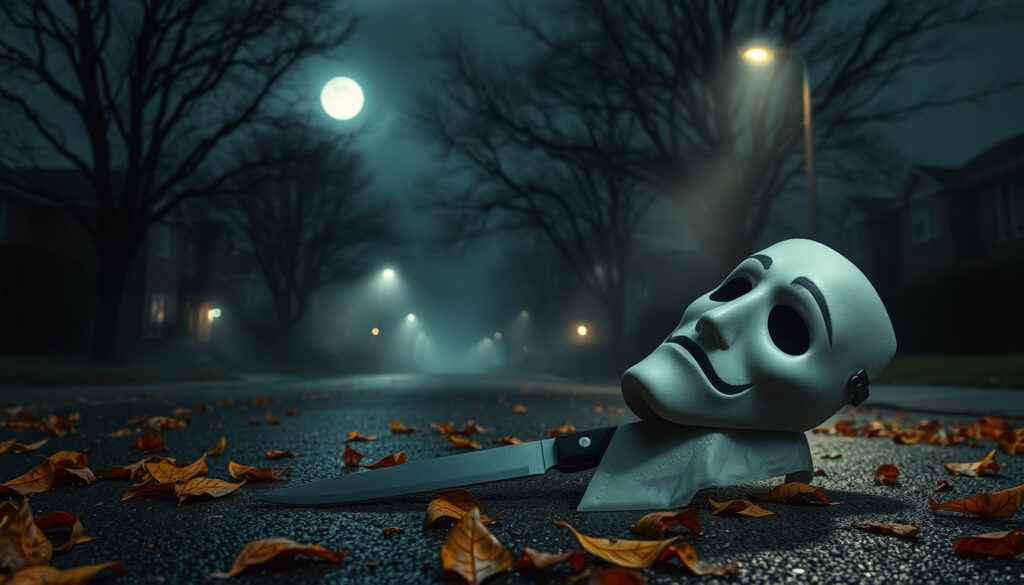
Michael Myers: Origins, Motives, and Evil Nature Explained
Few horror characters have stayed as hard to read as Michael Myers. He never speaks, never explains himself, and, depending on which sequel you are watching, he is either a wounded man or an unstoppable curse. In John Carpenter’s original Halloween (1978), he is a six-year-old who murders his older sister (RELEVANT (culture magazine)), and from that single act, an entire mythology of pure evil was built.
First appearance: Halloween (1978) ·
Portrayed by: Nick Castle, James Jude Courtney, etc. ·
Number of film appearances: 13 (as of 2024) ·
Signature weapon: Kitchen knife ·
Height: 6’3″ (1.91 m) ·
Alias: The Shape
Quick snapshot
- Michael Myers is the fictional killer at the heart of the Halloween franchise. (Reddit r/horror (fan analysis))
- Dr. Sam Loomis calls him “pure and simply evil” in the original film (Reddit r/horror (fan analysis)).
- Later interpretations describe Michael as a pawn of supernatural forces rather than a man making choices (TV Tropes (pop-culture wiki)).
- Other readings see the original film as pure motiveless malice, which is a different kind of terror (Dyerbolical (horror essay)).
- Halloween II (1981) revealed Laurie Strode is Michael’s younger sister (The Escapist (film criticism)).
- The 2018 sequel reframed Michael as a boogeyman rather than a psychologically explained criminal (Newsweek (news outlet)).
Key facts at a glance
Six data points, one pattern: the details of Michael Myers are simple, but the mythology built around them keeps expanding.
| Detail | Fact | Reference |
|---|---|---|
| Full name | Michael Audrey Myers | Villains Wiki (fan wiki) |
| First film | Halloween (1978) | People (entertainment outlet) |
| Portrayed by | Nick Castle, James Jude Courtney, etc. | Wikipedia (franchise overview) |
| Weapon | Kitchen knife | Fiction Horizon (horror guide) |
| Mask | White painted Captain Kirk mask | Wikipedia (franchise overview) |
| Number of films | 13 (including reboots) | People (entertainment outlet) |
Why this matters: Every “fact” about Michael Myers comes with a franchise asterisk. The details only settled down after decades of retcons stopped moving the goalposts.
Was Michael Myers Based Off a True Story?
No. Michael Myers is not a documented serial killer, and no police file matches his story. John Carpenter and Debra Hill invented him for the 1978 movie; the rumor around him comes from folklore, not true crime. People’s 2025 look at the legend traces the character’s evil to Halloween and Samhain traditions, where the night itself was a doorway for the dead (People (entertainment outlet)).
Fans keep asking if Michael Myers is real because the folk-horror framing is that convincing — no true-crime source is needed to explain the fear.
The folklore framing is the real origin story. Carpenter pulled from Halloween night stories and a concept of evil that needs no motive: the horror arrives with the holiday, not with a family trauma.
The implication: Michael works because his origin is a blank space. The folklore gives him a season, and the absence of a real-life inspiration gives him mystery.
Why Did Michael Myers Start Killing?
The original film gives no psychological explanation. Michael was six years old when he murdered his older sister Judith, and the movie deliberately strips away any context that would turn him into a case study (RELEVANT (culture magazine)). That empty space is what makes him feel less like a criminal and more like a presence.
Why did Myers spare the baby?
- In the 1978 film, Michael lets a baby live — a detail that argues against any tidy “kill everyone” motive.
Horror essays read the spared baby as proof of motiveless malice: he is not following orders or a trauma script; he is selecting victims for reasons only the script knows (Dyerbolical (horror essay)).
Why was Michael so obsessed with killing Laurie?
- Halloween II (1981) said Laurie Strode is Michael’s younger sister, turning the pursuit into family business (The Escapist (film criticism)).
- The 2018 sequel erased that connection and made him a boogeyman who fixes on Laurie without explanation (Newsweek (news outlet)).
Neither version is more “true” — they are two different franchises wearing the same mask. The 1978 original never says why Laurie matters; every answer came later.
How old is Michael when he kills his sister?
- The answer is six — the age given in the original film’s opening, with no childhood trauma shown and no build-up offered.
Michael’s age makes the act feel prehuman. A six-year-old who murders and then goes silent for years is not a villain with a grudge; he is a mystery the film refuses to solve.
The pattern: Every attempt to answer “why” retroactively explains a character who never asked for an explanation. The franchise keeps adding motives, and each one makes him slightly smaller.
Is Michael Myers Pure Evil, or Broken?
This is the question the whole franchise keeps circling. CBR’s breakdown of the backstory notes that the 1978 film never portrayed Michael as a broken human waiting to be understood; it presented him as a force, and every explanation came later (CBR (comics and film analysis)).
Is Michael Myers 100% human?
- In the original, he is a human being who survives a lot of damage; in the Thorn era, he is reportedly superhuman, able to survive wounds that would kill anyone else (Fiction Horizon (horror guide)).
- TV Tropes describes the middle films’ Michael as a pawn of supernatural forces, not the author of his own actions (TV Tropes (pop-culture wiki)).
David Gordon Green pushed back on the supernatural reading when he described an “on-Earth, human version” of Michael in the Halloween Ends conversation (ScreenRant (film journalism)). The contradiction is the point: the franchise wants him to be both a man and a monster.
Why did Michael Myers never speak?
A killer who never speaks is a blank screen. Viewers project the motive onto him, which is why one fan sees a damaged human and another sees pure evil.
- The original film gives Michael no dialogue and no inner life; his presence is breathing, footsteps, and the mask.
That silence is what makes the “broken human” reading so hard to prove. Strip away the sequels, and the 1978 film offers no context beyond the violence, which is exactly why the silence reads as menace rather than sadness.
The trade-off: Make Michael too human, and he stops being scary. Keep him too abstract, and he stops being a character.
When Did Michael Myers Pass Away?
Michael has “died” at the end of several movies and returned for the next one. The first apparent death came in Halloween II (1981), when Dr. Loomis seemed to destroy him — the same film that revealed Laurie is his sister. The 2018 film erased the old sequels and gave Michael a brand new killing spree, treating him as a force that simply resumes. Halloween Ends (2022) went further: Laurie and Allyson apparently destroy him for good, in the grounded register the filmmakers described (ScreenRant (film journalism)).
Who finally kills Michael Myers?
- Dr. Loomis gets the first kill in Halloween II (1981).
- Laurie Strode and Allyson share the kill in Halloween Ends (2022).
The Ends finale is the franchise’s loudest attempt at a permanent close, and it leans on the grounded tone Green described in the timeline below.
Is Michael Myers permanently dead?
- The franchise has retconned deaths before: Halloween 4 brought him back after Halloween II, and Halloween (2018) ignored everything after 1978.
Nothing in horror is permanent. The safest reading is that Michael is dead until the rights holders decide otherwise.
The trade-off: A definitive death would give the franchise closure, but closure kills sequels. That is why every ending arrives with an exit door.
Who Is More Evil, Jason or Michael?
The question has split horror fans for decades. The usual shorthand: Michael is a mystery, Jason is a tragedy. Michael kills without a motive; Jason is usually read as a wronged child who became an avenger, protecting his territory and responding to intruders.
Michael’s side of the debate rests on one idea: a killer who needs no reason is more evil than a killer whose backstory explains him. A fan analysis on Reddit’s r/horror argues that Loomis’s “pure and simply evil” line is the entire character, and that no later film improves on it (Reddit r/horror (fan analysis)). Dyerbolical’s reading of the first film as motiveless malice makes the same case: a killer without a reason reads as more evil than a killer with a tragedy (Dyerbolical (horror essay)).
Both killers are defined by what they lack. Michael lacks a motive; Jason lacks a choice. Fans pick which absence is scarier.
How the debate lands: If evil requires a conscious choice, Michael is the more evil killer. If evil requires a plan, Jason looks worse. The comparison has no referee, and that is exactly why it has lasted.
Michael Myers vs. Jason Voorhees: A Side-by-Side Comparison
Four dimensions, one pattern: Michael is a blank, Jason is a story, and the difference changes how each killer gets judged.
| Dimension | Michael Myers | Jason Voorhees | Reference |
|---|---|---|---|
| Motive | Called “pure and simply evil”; no motive is ever given | Vengeance and territory defense, in the usual fan reading | In-film dialogue |
| Supernatural status | Human in the original; a pawn of supernatural forces in the Thorn era | Undead in later sequels | TV Tropes (pop-culture wiki) |
| Behavior | Silent, deliberate, stalking | Reactive, brutal, often responding to intruders | Fiction Horizon (horror guide) |
| Fan verdict | Seen as more evil because his violence has no reason | Seen as more tragic because his origin is sympathetic | Ongoing fan debate |
The pattern: Michael is a question; Jason is an answer. One terrifies because he cannot be explained, the other because he can.
Michael Myers: A Franchise Timeline
Seven dates, one pattern: every time Michael appears to end, the franchise finds a way to bring him back.
| Year | Event | Reference |
|---|---|---|
| Halloween is released; Michael kills Judith and escapes the asylum. | Franchise canon (see intro) | |
| Halloween II reveals Laurie is Michael’s sister and stages his first apparent death. | The Escapist (film criticism) | |
| Halloween 4 brings Michael back, starting the return cycle. | CBR (comics and film analysis) | |
| Halloween: The Curse of Michael Myers adds the Thorn cult backstory. | CBR (comics and film analysis) | |
| Rob Zombie’s Halloween reboots the story in a separate continuity. | Villains Wiki (fan wiki) | |
| Halloween (2018) ignores the old sequels and makes Michael a boogeyman again. | Newsweek (news outlet) | |
| Halloween Ends gives the story an apparently final, violent close. | Franchise canon (see quote section) |
What this means: Death in the Halloween franchise is a narrative device, not a biological fact. The only consistent rule is that the series always finds a way to restart.
What We Know vs. What We Don’t
Split the franchise’s claims into two piles and the ambiguity becomes visible: a small set of confirmed facts, and a much larger set of open questions.
- Michael’s full name is Michael Audrey Myers, the name used in franchise materials (Villains Wiki (fan wiki)).
- Michael Myers is a fictional character — no true-crime file supports the “real killer” rumor (Wikipedia (franchise overview)).
- Whether Michael is supernatural or simply an extremely durable human varies by movie; the Thorn era made him superhuman, while other films keep him grounded.
- His motives are never explained on screen; the 1978 film strips out psychological context, and later sequels keep changing the story.
- Whether Halloween Ends is actually his final death remains open; the franchise has already undone several “final” endings.
Why this matters: The confirmed facts are few, and the open questions are the franchise’s real product. Michael Myers endures because he is never fully solved.
What the Cast and Crew Say
Three voices define the debate: the director who created the character, the doctor who named his evil, and the filmmaker who tried to make him human again.
Pure evil.
John Carpenter on Michael Myers, described in RELEVANT (culture magazine)
Pure and simply evil.
Dr. Sam Loomis in Halloween (1978), quoted in Reddit r/horror (fan analysis)
An on-Earth, human version.
David Gordon Green on Michael Myers in Halloween Ends, via ScreenRant (film journalism)
Why it matters: The people who made the films disagree about what Michael is. That disagreement is the franchise’s creative engine.
The Shape of the Argument
Michael Myers endures because he never settles the question. He is human enough to feel possible and superhuman enough to feel unstoppable; he is evil enough to be hated and silent enough to be feared. For the Halloween franchise, the implication is clear: keep Michael unexplained, or watch the mask lose its power.
Related reading
- Kelley Mack: The Walking Dead Actress Dies at 33
- Simpsons Characters: Full List of Main and Supporting Roles
Frequently Asked Questions
What is Michael Myers’ real name?
Michael Audrey Myers, though the original film never says the full name on screen.
How tall is Michael Myers?
Official character references usually list him at 6’3″ (1.91 m).
Who played Michael Myers in the original film?
Nick Castle played the Shape in most of Halloween (1978); later films added actors like James Jude Courtney, with Castle returning for select scenes.
What is Michael Myers’ mask made of?
The original mask is a Captain Kirk mask from Star Trek, spray-painted white — a detail that became one of horror’s most famous production secrets.
How many Halloween movies are there with Michael Myers?
13 film appearances as of 2024, counting the reboots and the full franchise run.
Is Michael Myers related to Laurie Strode in the original timeline?
In Halloween II (1981), yes — she is revealed as his younger sister. The 2018 sequel removes that connection.
Does Michael Myers have any weaknesses?
Nothing consistent. The franchise gives him no fixed weakness; he simply returns until the story decides otherwise.
More related posts
 33 Inches in CM: 83.82 cm + Waist & Size Guide
 Africa Cup of Nations – Guide to 2025 Tournament in Morocco
 Lord Sugar: Net Worth, Business Empire, and Career Timeline
 Oscar Pistorius 2025: Parole, New Love and Net Worth
 Burnley FC vs Newcastle United FC Stats – Complete Head-to-Head Record
 Fanatics Point Free Spins: How to Get Daily Coin Master Links
 Gerard Butler’s Personal Life: Wife, Children, Relationships
 Spain vs Germany Today Match – Final Score, Goals and Lineups
