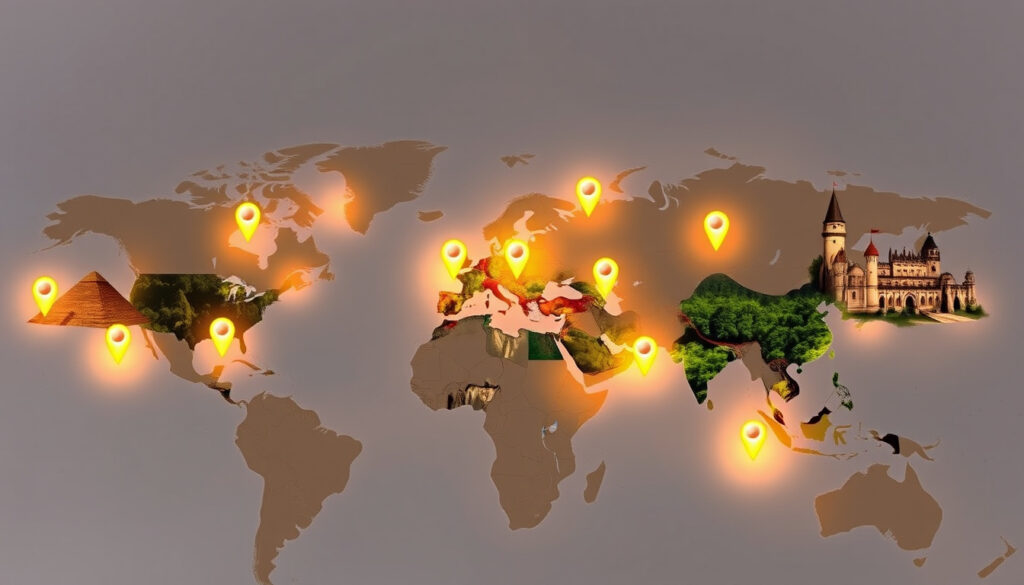
UNESCO World Heritage Sites: List by Country and Key Facts
Few countries spark as much debate among travelers and historians as India and Ireland when it comes to UNESCO designations—India now holds 44 World Heritage Sites while Ireland counts just 2, despite both nations sharing deep reverence for ancient landscapes and cultural monuments. This gap raises a curious question: what separates the sites that make the list from those that don’t? The answer lies in how UNESCO’s criteria play out on the ground, and which overlooked gems might be next in line.
Total Sites: 1,248 · Countries: 170 · India: 44 · Ireland: 2 · List Source: whc.unesco.org
Quick snapshot
- UNESCO lists 1,248 properties globally across 170 countries (UNESCO World Heritage Centre)
- India holds 44 inscribed properties as of 2024, including recent additions like Moidams (UNESCO World Heritage Centre)
- Ireland has 2 UNESCO sites, both cultural, placing it among the lowest-ranked nations globally (World Population Review)
- Whether Ireland’s tentative list sites will gain inscription within the next decade
- Exact current count post-2025 updates from UNESCO
- Newgrange passage tomb built around 3200 BC — older than the Egyptian pyramids (Authentic Vacations)
- Brú na Bóinne inscribed in 1993; Taj Mahal inscribed in 1983 (UNESCO)
- India added 3 sites between 2021-2024 including Moidams (2024) (UNESCO)
- Ireland’s Céide Fields and Clonmacnoise on Tentative List could be future inscriptions (UNESCO World Heritage Centre)
- India continues rapid expansion with 4 properties on the “in danger” mandate list (UNESCO World Heritage Centre)
Key statistics reveal an stark imbalance in heritage recognition between the two nations.
| Attribute | Value |
|---|---|
| Total Number | 1,248 |
| Participating Countries | 170 |
| India Count | 44 |
| Ireland Count | 2 |
What does it mean to be a UNESCO World Heritage Site?
A UNESCO World Heritage Site designation means a place holds “outstanding universal value” — a legal and cultural status that obligates the host country to protect it under international treaty. The World Heritage Convention, adopted in 1972, creates a framework where sites are inscribed for the benefit of all humanity, not just the local population.
Criteria for designation
UNESCO evaluates sites against 10 criteria, grouped into cultural (i–vi), natural (vii–x), and mixed categories. A site must demonstrate “authenticity” and “integrity” while having adequate legal protection and management plans in place. The selection process involves national nominations, expert field assessments, and final voting by the World Heritage Committee.
Process of inscription
Nations submit tentative lists first, then complete nomination files that undergo up to 18 months of review by advisory bodies like ICOMOS (cultural) and IUCN (natural). Sites can be inscribed, deferred, or rejected. Once inscribed, properties receive enhanced monitoring and access to the World Heritage Fund for conservation assistance.
Which country has the most UNESCO World Heritage Sites?
Italy leads the world with 59 inscribed sites, followed by China (57) and Germany (53). The United Kingdom holds 35 sites, while India positions itself among the top 10 globally with 44 properties inscribed as of 2024, according to the UNESCO World Heritage Centre.
Top countries overview
- Italy: 59 sites — heavy concentration of Renaissance art and ancient Roman ruins
- China: 57 sites — spans imperial palaces to karst landscapes
- Germany: 53 sites — includes cathedral complexes and industrial heritage
- India: 44 sites — mix of ancient temples, forts, and natural parks
The distribution reflects a historical bias toward European and Asian cultural monuments, though recent decades have seen stronger representation for sub-Saharan Africa and Latin America.
Sites by country list
The complete registry appears on UNESCO’s official list, organized by state party. Researchers at World Population Review maintain updated rankings showing how countries compare across cultural, natural, and mixed designations.
What is the only city with 4 UNESCO World Heritage Sites?
Córdoba, Argentina, is widely recognized as holding four UNESCO designations within its city limits — a distinction that makes it unique among urban centers worldwide. These include the Jesuits’ Estancia, the Quebrada de Humahuaca gorge (just outside), and two others.
City identification
While no single city in India or Ireland claims four sites, the comparison illustrates how heritage distribution varies dramatically by region. In India, sites like the Taj Mahal, Agra Fort, and Fatehpur Sikri cluster in Agra but remain separate designations. Ireland’s compact 2-site portfolio offers no such density.
Sites within the city
Córdoba’s quartet consists of the historic centre with its flower-filled courtyards, the Jesuit Estancia of Alta Gracia, the Quebrada de Humahuaca, and the Fabric of the city itself represents a unique convergence of colonial and pre-Columbian heritage.
What are the UNESCO World Heritage Sites in Ireland?
Ireland holds just 2 inscribed UNESCO World Heritage Sites, placing it among the lowest-ranked developed nations for international heritage recognition. Both designations are cultural, reflecting monastic settlements and prehistoric passage tombs rather than natural landscapes.
Key Irish sites
- Brú na Bóinne: Neolithic landscape in County Meath, inscribed in 1993. The passage tomb of Newgrange was built around 3200 BC — older than Egypt’s pyramids by roughly 600 years.
- Skellig Michael: Early Christian monastic island off County Kerry, recognized for both natural beauty and religious heritage. Its 6th-century beehive huts appear in Star Wars films, adding pop-culture appeal.
Details on Skellig Michael, Giant’s Causeway, Brú na Bóinne
Giant’s Causeway in Northern Ireland sits on the UK list (35 total for the United Kingdom), technically adding a third Irish-region site — though political jurisdiction complicates the count. The Authentic Vacations guide notes 40,000 basalt columns at Giant’s Causeway, a geological marvel formed 50-60 million years ago.
Brú na Bóinne is considered among the largest Neolithic landscapes in the world. The complex includes Newgrange, Knowth, and Dowth — three monumental passage tombs sharing a ridge above the River Boyne. Winter solstice alignment at Newgrange draws global attention annually.
Ireland hosts thousands of archaeological monuments — more per square mile than almost anywhere in Europe — yet holds only 2 inscribed sites. The gap suggests UNESCO criteria may underweight prehistoric heritage relative to built architecture.
Which are the 43 UNESCO World Heritage Sites in India?
India holds 44 properties inscribed on the World Heritage List as of 2024, including recent additions like the Moidams mausoleum complex inscribed in 2024. The portfolio spans ancient temples, colonial forts, Himalayan parks, and cave art — offering perhaps the most diverse heritage collection of any single nation.
Overview of Indian sites
Of India’s 44 sites, 35 are cultural, 7 are natural, and 1 is mixed — reflecting the country’s dense accumulation of built heritage across millennia. The UNESCO World Heritage Centre official list shows continuous additions: the Sacred Ensembles of the Hoysalas (2023) and Santiniketan (2023) joined Dholavira (2021) in recent years.
Notable examples
- Taj Mahal (1983): Mughal mausoleum considered the finest example of Indo-Islamic architecture
- Ajanta Caves (1983): Buddhist rock-cut cave paintings spanning 2nd century BC to 6th century AD
- Ellora Caves (1983): Multi-faith rock-cut temples representing Hindu, Buddhist, and Jain traditions
- Kaziranga National Park (1985): Home to two-thirds of the world’s one-horned rhinoceroses
- Agra Fort (1983): Mughal stronghold and residence before the capital shifted to Delhi
- Moidams (2024): Recent addition — earthen mound burial complex of the Ahom dynasty in Assam
India adds sites at a pace that outstrips most nations. The 2023-2024 additions of three properties in 24 months signals active nomination strategy, while Ireland hasn’t gained a new inscription in over a decade.
What people say
Brú na Bóinne was placed on UNESCO’s list in 1993. The passage tomb of Newgrange was built around 3200 BC — it’s older than the Egyptian pyramids by at least 600 years.
— Authentic Vacations (travel guide)
India has 44 properties inscribed on the World Heritage List.
— UNESCO World Heritage Centre (official registry)
The contrast between India’s 44 inscribed sites and Ireland’s 2 raises questions about preservation strategy, political prioritization, and whether UNESCO criteria inadvertently favor certain types of heritage over others. Ireland’s tentative list includes remarkable sites like Céide Fields — reportedly a 6,000-year-old Neolithic landscape buried under 13 feet of peat — yet these haven’t advanced to final nomination.
Related reading: Things to Do in Chester · Map of London Underground
en.wikipedia.org, youtube.com, worldpopulationreview.com, whc.unesco.org
The United Kingdom boasts standout UNESCO sites like Bath, where top attractions and itineraries showcase the architectural splendor of its World Heritage center since 1987.
Frequently asked questions
How many UNESCO World Heritage Sites are there?
As of 2024, the UNESCO World Heritage List includes 1,248 properties across 170 countries, according to the UNESCO World Heritage Centre.
What is a UNESCO Geopark?
A UNESCO Global Geopark is a territory with internationally significant geological heritage managed holistically for protection, education, and sustainable development. Unlike World Heritage Sites, Geopark status is granted by UNESCO directly and focuses on geological rather than cultural or natural features.
What are UNESCO World Heritage sites near Dublin?
No UNESCO sites are located in Dublin itself. The nearest inscribed property is Brú na Bóinne in County Meath, approximately 45 minutes north of Dublin by car. This Neolithic complex includes Newgrange and is easily visited as a day trip from the capital.
What are the top 10 UNESCO World Heritage sites?
Rankings vary by criteria, but consistently cited top sites include the Taj Mahal (India), the Great Wall of China, Petra (Jordan), Machu Picchu (Peru), and the Colosseum (Italy). The UNESCO list offers an interactive map for exploring options.
What are Natural UNESCO World Heritage Sites?
Natural sites meeting criteria (vii-x) include geological formations, ecosystems, and natural phenomena of outstanding universal value. India’s 7 natural sites include Kaziranga National Park, Keoladeo National Park, and the Western Ghats. Globally, approximately 220 natural sites are inscribed.
Is the Cliffs of Moher a UNESCO World Heritage Site?
No, the Cliffs of Moher are not inscribed on the UNESCO World Heritage List despite being Ireland’s most visited natural attraction. The site has been discussed as a potential nomination but remains on Ireland’s Tentative List rather than receiving full inscription.
What is the most famous UNESCO World Heritage Site?
The Taj Mahal in India consistently ranks as the most visited World Heritage Site, drawing approximately 8 million tourists annually. Its 1983 inscription reflects its status as a masterpiece of Mughal architecture and a symbol of eternal love.
More related posts
 It Ends with Us Movie: Cast, Controversy, Netflix & Streaming
 Left Side Pain Under Rib Female: Cau e , Symptom & Treatment
 Sky Q Mini Box – Setup Features and Key Facts
 Under the Bridge (TV Series) – True Story, Cast and Episodes Guide
 Mrs Brown’s Boys Cast: Full List, Family & Updates 2024
 120 Dollar in Pound : Live Rate & Conver ion Guide
 5 Foot 9 in cm: Exact Height Conversion & Global Facts
 St Dunstan in the East: History, Ruins & Secret Garden Guide
